Kossuth-A Symphonic Poem

This slideshow requires JavaScript.

Bartok’s Kossuth, A Symphonic Tone Poem
Kossuth, a symphonic poem written by Béla Bartók in 1903, was written in honor of the Hungarian politician Lajos Kossuth, a hero of the Hungarian Revolution of 1848. Bartók’s symphonic poem music tells the story of Kossuth, starting with a portrait of him, recounting the revolution and in the eight movements paints a picture of the Austrians approaching by using a minor key parody of the Austrian National Anthem, the ensuing battle and defeat of the Hungarians.
The music of Richard Strauss had a strong influence on Bartók, in particular his symphonic poem Ein Heldenleben, which literally means a heroic life or a hero’s life. Ein Heldenleben movements are as follows:
1. Der Held (The Hero)
2. Des Helden Widersacher (The Hero’s Adversaries)
3. Des Helden Gefährtin (The Hero’s Companion)
4. Des Helden Walstatt (The Hero at Battle)
5. Des Helden Friedenswerke (The Hero’s Works of Peace)
6. Des Helden Weltflucht und Vollendung (The Hero’s Retirement from this World and Consummation)
Throughout Ein Heldenleben, Strauss employs the technique of leitmotif that Richard Wagner used so liberally, but most always as elements of its enlarged sonata-rondo symphonic structure. With the influence of Strauss in addition to Bartok’s strong nationalistic feeling towards Hungary Bartok later wrote in his autobiography “…It was worth while creating something specifically Hungarian in music.” [i]
Lasting around twenty minutes, Kossuth is in ten movements, as follows:
1. Kossuth
2. What sorrow weighs on your soul, dear husband? (Kossuth’s wife)
3. The fatherland is in danger
4. Once we lived better days
5. But our plight grew worse
6. To battle
7. Come forth, ye Magyar heroes of true valor
8. …(Theme of the Austrian army slowly approaching)
9. All is over
10. A hopeless silence reigns
The Kossuth premiered in Budapest January 13, 1904 and created a sensation at its Budapest premiere. Bartók’s own program notes for the piece were as follows:
The year 1848 is one of the most eventful in Hungarian history. It was the year of the Hungarian revolt-a life and death struggle of the nation for freedom. The leader, the heart and soul of this struggle, was Lajos (Louis) Kossuth. As Austria saw, in 1849, that the war was going against her, she concluded an alliance with Russia. A crushing blow was inflicted upon the Hungarian Army, and the hope of an independent Hungarian kingdom was shattered-apparently forever. These events serve as the basis for the symphonic poem. [ii]

The Kossuth funeral march is Bartók’s piano transcription of the ninth and tenth movements of the symphonic poem. Bartók indicated in his program notes that “the thematic material beginning in bar 23: is a direct borrowing of the theme of Liszt’s Hungarian Rhapsody No. 2.” [iii]
The Hungarian Gypsy Scale is a name given by different authorities to two different scale forms. The more commonly used of these scales is the fourth mode of the Double Harmonic Scale, it can be formulated by sharpening the 4th degree of the harmonic minor scale to introduce an augmented second.
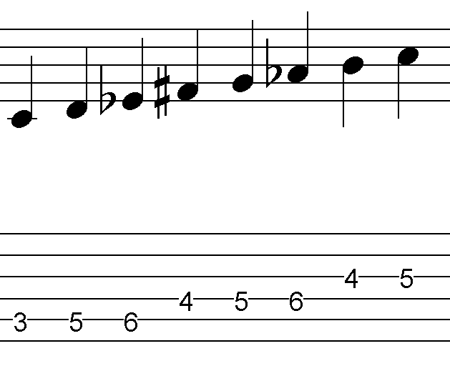
Scale in Corresponding key of Kossuth:
A: A B C D# E F G# or A B C D# E F G
The thematic material or Leitmotif of Kossuth is derived from the Hungarian Scale and reappears with different variations and represents both Kossuth as well as the concept of Magyar nationalism. Dance rhythms called verbunkos are hybrids of original musical materials, which are derived from diverse ethnic sources, which originated in the seventeenth century and developed into the nineteenth century Viennese classicism described as style hongrois. Verbunkos are regarded as the ‘soul’ of Hungarian/Magyar Music and contribute to the strong Hungarian nationalistic feel of the Kossuth Symphonic Poem. These rhythms include long-short-short-long choriambus, an accented short-long ‘Scotch Snap’ as well as Kuric fourths, which use a rhythmic rebound between the dominant drone and the tonic in the upper voices.
Kossuth Funeral March has an ABA1 form in a minor. An introduction leads into the A section. The Kossuth Leitmotif comes in and is played over the somber double dotted funereal rhythm along with the short short long rhythm of the style hongrois. An ascending sequence with a melodic variation, which is derived from Liszt’s Hungarian Rhapsody No. 2, is the B section. The concluding A section is a coda, which uses a similar chord progression of the introduction.
Bartók continued to collect, study and do extensive research on Hungarian folk tunes as well as other countries such as Romania, Transylvania and North Africa. His compositions often reflected his research, and Bartók managed to develop a style that was uniquely his own, which was a combination of his ethnomusicology research of folk tunes and rhythms, a virtuosic and percussive technique, which he managed to skillfully incorporate along with the training he received at the Budapest Conservatory. Bartók eventually migrated to New York City in the USA, sadly due to political turmoil of the time, and struggled to earn a meager living with his ethnomusicology research, piano performances, concerts and compositions. His deep respect of humanity life and nature will always be admired. Although, his music received more praise posthumously, Bèla Bartók’s music continues to educate inspire and delight music lovers worldwide.

Follow Me on Pinterest

[i] BÉLA BARTÓK, Lajos Lesznai, 1961, Great Britain J.M. Dent & Sons Ltd Aldine House, p. 28
[ii] Béla Bartók, Piano Music of Béla Bartók, The Archive Edition, Edited by Dr. Benjamin Suchoff
[iii] Béla Bartók, Piano Music of Béla Bartók, The Archive Edition, Edited by Dr. Benjamin Suchoff
The History of the ‘Moonlight’ Sonata


This slideshow requires JavaScript.

The first movement of Beethoven’s Opus 27 No. 2 C# minor sonata was very popular in Beethoven’s day, to the point of exasperating the composer himself, who remarked to Czerny, ‘They are always talking about the C# minor Sonata surely I’ve written better things.’ Nearly two hundred years later, it still remains the most popular and downloaded piece of ‘classical’ music.

The title Moonlight Sonata actually didn’t come about until several years after Beethoven’s death. In 1836, German music critic, Ludwig Rellstab wrote that the sonata reminded him of the reflected moonlight off Lake Lucerne. Since then, Moonlight Sonata has remained the “official” unofficial title of the sonata.

‘Sonata quasi una fantasia’ is the title Beethoven gave his fourteenth sonata. Unlike the formal Sonata form of the classical period, Fantasia commonly describes a free-form classical musical piece. Marking the beginning of Beethoven’s second stylistic period, Opus 27 No. 2 does not follow the traditional sonata form. Beethoven additionally uses traditional musical mourning devices called Trauermusik, in a very untraditional way. Trauermusik consists of Lament Bass, repetitive accompaniment figures, and chant. Other famous examples of chant are Mozart’s Masonic Funeral Music and the Requium. Dotted monotone anacrusis permeate the first movement reminiscent of the tolling of funeral bells, recall the previous piano sonata Opus 26, Marcia sulla morte de’un eroe, which anticipates Chopin’s opus 35 Bb sonata’s famous ‘Marche Funebre’ and later the main theme of Beethoven’s ‘Eroica’ Symphony’s ‘Marcia Funebre’.

What changes in Beethoven’s life led to these transformations in his music?

In 1800-1802 Ludwig van Beethoven experienced devastating internal turmoil in trying to come to terms with his hearing loss. To the outside world, his life seemed to be ideal, with his success as a virtuoso pianist and as a successful, sought after composer in Vienna. He gradually began to withdraw from society and friends, however, as he felt it would be detrimental to his successful career as a musician if people found out he was going deaf. People felt he was being misanthropic, yet it was quite the opposite. Beethoven lived in a great deal of solitude and loneliness due to his impending and eventual complete deafness, which would eventually have a profound effect on his spiritual and creative growth as a composer and a musician. The years of 1800-1802 were a transformative period in Beethoven’s life, and marked the beginning of his second stylistic period. As Beethoven’s outer hearing deteriorated, his inner hearing continued to grow.

Beethoven sought treatment in the village of Heilgenstadt in the late spring of 1802 until October of that year. Full of despair over the unsuccessful treatment, he considered ending his life. In a famous letter known as the Heilgenstadt Testament written to his brothers, he wrote “Thanks…to my art I did not end my life by suicide.”

Over and over in Beethoven’s music themes of victory over tragedy abound. In the internal struggle he faced,  his music often showed the greatest despair and sorrow, yet always transcended into triumphant victory. With that same inner struggle, Beethoven learned to transcend deafness and still be victorious in creating greater and greater masterpieces.

During the late 1790s, Beethoven’s music began to show changes, as well as enlargement of form. After the Heilgenstadt Testament, Beethoven expressed dissatisfaction with his compositions and according to Czerny was “determined to take a new path.” [1] The changes included strong links between sonata movements, intensified drama, harmonic instability and motivic elements affecting the larger form.

This Sonata could be interpreted as Beethoven beginning to come to terms with his impending eventual deafness. The mourning and loss of the Adagio Sostenuto with its modal changes, dissonances, rhythms and chants representative of Trauermusik followed by the rage of the stormy third movement, were his way of expressing how he felt about this affliction of deafness while writing the most extraordinary music and not being able to hear it.

Beethoven would live most of his life in a great deal of loneliness and despair with most of his life devoted to the development of his art and creativity. As this sonata was written towards the beginning of his second stylistic period many masterpieces would follow the ‘Sonata Quasi Una Fantasia’.

Jamila Sahar
[1] Timothy Jones, BEETHOVEN The “Moonlight” and other Sonatas, Op 27 and Op 31, p. 15

Funérailles – Harmonies Poétiques et Religieuses

This slideshow requires JavaScript.

Harmonies Poetiques et Religieuses is a piano suite comprised of ten compositions, Liszt dedicated the suite to his companion princess Sayn-Wittgenstein.

I. Invocation

II.   Ave Maria

III.  Benediction de Deus dans la Solitude

IV.  Pensee des Morts

V.  Pater Noster

VI.  Hymne de L’enfant a Son Reveil

VII.   Funerailles

VIII.   Miserere D’Apres Palestrina

VIIII   Andante Lagrimoso

X.      Cantique d’Amour

Many innovative concepts are explored in this suite such as constantly changing meters, no key signatures in addition to emphasis on the tritone.  Liszt develops these innovations further in his later compositions.  Fifty years later Liszt once again returned to the exploration of atonality in his Bagatelle ohne Tonart (Bagatelle Without Tonality).

On the autograph manuscript of Funérailles,Liszt writes October 1849.  Liszt indicated it was an elegy written as a tribute to three of his friends who died in the failed Hungarian Revolution.  Prince Felix Lichnowsky,  Count Laszlo Teleki and the Hungarian Prime Minister, Count Lajos Batthyany. It was a colossal defeat to the Hungarian people.

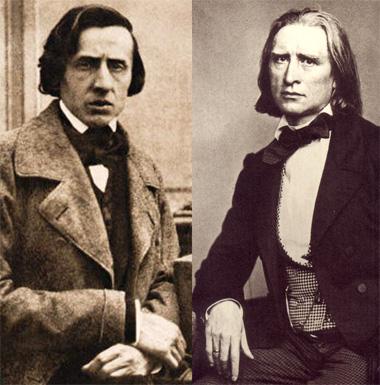
Death of Chopin October 1849

The intuitive use of material from Chopin’s heroic Ab Major Polonaise Opus 53 leads to speculation that this piece was more than an elegy to the Hungarian people but also an elegy to his dearly departed colleague F. Chopin.